Every Anchor Drop Is a Crime Scene — In a Growing Number of the World's Best Anchorages
Traditional mooring systems were designed for a world that didn't know better. Marine science now does.
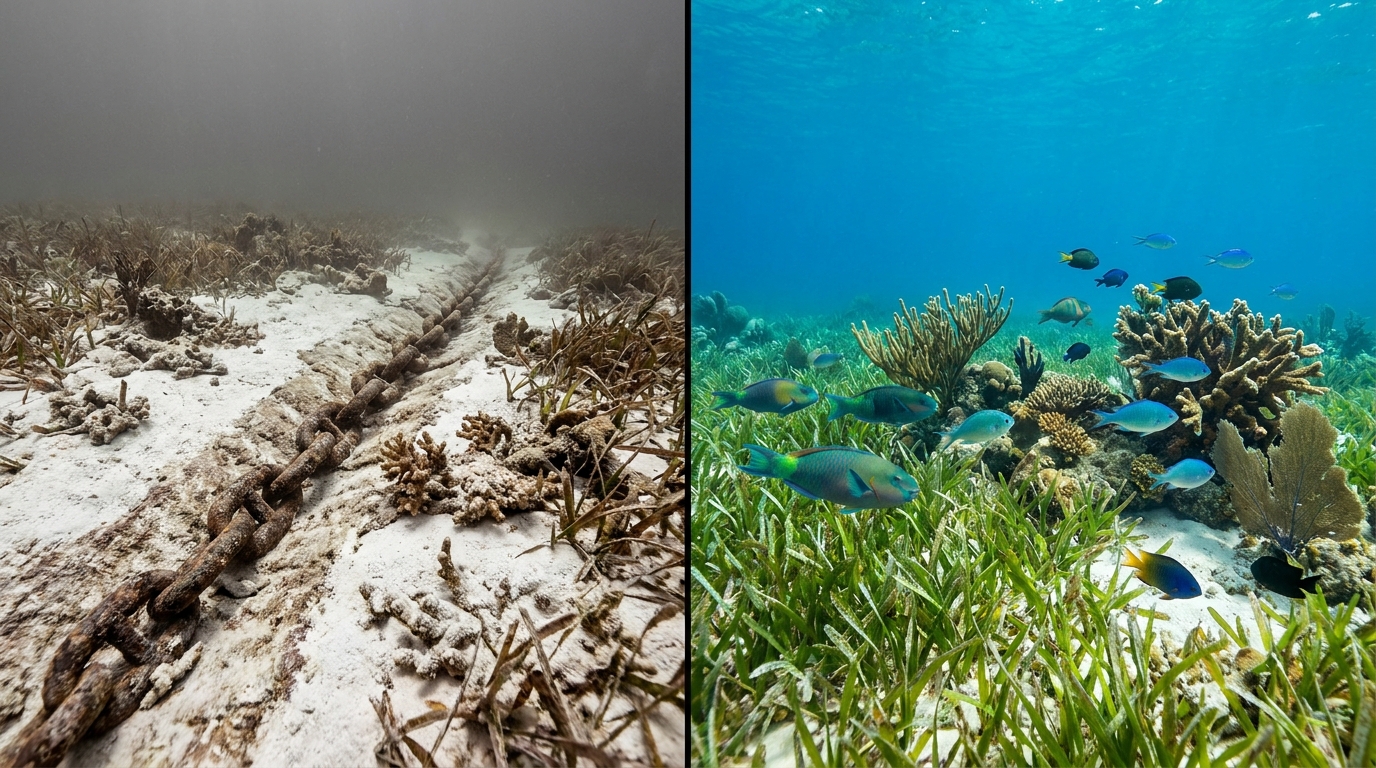
The same seabed. Two mooring philosophies.
Traditional mooring systems — concrete block, chain, surface buoy — were designed for a world that didn't know better. Marine science now does. Every movement of a moored vessel transmits force along the chain, which sweeps the seabed in an arc. Over months and years, that arc scours away everything: seagrass meadows, coral colonies, benthic ecosystems that took decades to form.
The regulatory response is no longer gradual. It is accelerating — and the fines are real.
The rules are tightening — and enforcement is following.
| Jurisdiction | Regulatory Action |
|---|---|
| Balearic Islands (Spain) | Fines exceeding €600 per vessel per infraction for anchoring in protected Posidonia meadows |
| Croatia | Active enforcement regime introduced. Protected zone anchoring bans expanding. |
| France / Corsica | Progressive tightening of anchoring in Marine Protected Areas. Further restrictions pending. |
| Southeast Asia | Indonesian AMDAL environmental permitting requirements — Helix compliant by design |
| New Zealand | Resource consent requirements for mooring installations. Helix permitted approach. |
This Is Not Environmentalism Inconveniencing Commerce. This Is Regulation Creating a Mandatory Market.
The jurisdictions imposing the heaviest fines — the Balearics, the French Riviera, the Adriatic — are also the world's most desirable yachting and charter destinations. The vessels most exposed to enforcement risk are the ones with the most to lose.
For superyacht owners and managers, eco-certified compliant mooring is no longer a preference. In an increasing number of premium destinations, it is the only legal option.
There is a certified alternative.
Helix eco-moorings deliver safe, certified holding without touching surrounding seabed.